Sustainability management policies and goals.
Based on the company’s vision, “To be a leader in the business of sustainably improving lives through creative innovation,” and its
mission, “To elevate the standards of products and services beyond expectations with environmentally conscious innovation to create sustainable value and a better quality of life,” the Board of Directors recognizes that achieving added value, growth, and sustainable success requires a balance in all dimensions—economic, environmental, and social—under the principles of corporate governance, business ethics, respect for human rights, and stakeholder participation throughout the value chain. Furthermore, the company embraces the Sufficiency Economy Philosophy. This is a philosophy that His Majesty King Bhumibol Adulyadej the Great, the Supreme Patriarch, expressed to the Thai people since 1974: living under the principles of moderation, reason, and resilience, based on the conditions of “knowledge” and “morality.” This is integrated into the company’s business ethics and operational policies through activities conducted with maximum efficiency and effectiveness.
The company has integrated these principles in line with its vision, mission, and business context, taking into account stakeholders
and key sustainability issues throughout the value chain. This has resulted in concrete sustainability strategic plans and operational guidelines to support the United Nations Sustainable Development Goals (SDGs). The company has established a sustainability policy as a guiding framework for all units, integrating it into the value chain from sourcing, production, distribution, sales and marketing, to after-sales service, in order to create positive outcomes for people, the planet, and profits. (People-Planet-Profit) is achieved through five business sustainability strategies (5 Megatrends Towards Future Sustainability for SMPC) and key sustainability issues such as efficient resource and energy use, water and wastewater management, waste reduction-sorting-recycling, pollution and greenhouse gas reduction, development of safe and environmentally friendly products and services, enhancing safety and human rights in the workplace, capacity building for employees and communities, supplier governance, and creating transparent and verifiable value for customers and shareholders.
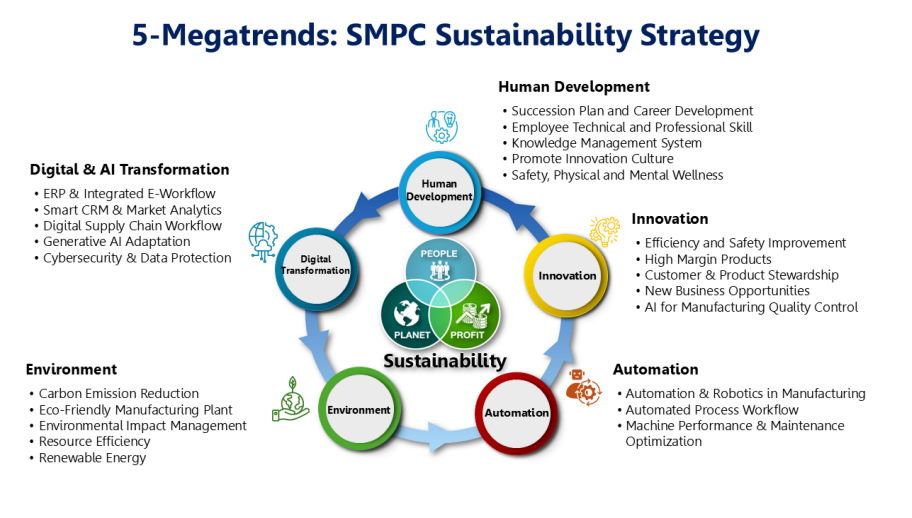
Sustainability strategies and support for the Sustainable Development Goals.
Assess key issues for sustainability.
Human Development
Human resources are the key for driving the organization and are an important force in leading the company to grow sustainably. The company therefore focuses on creating a working environment that supports learning, skill development, and enhancing the potential of employees at all levels. The company is committed to develop employees to be leaders who have both business ability and a good ethics towards society.
The company places importance on comprehensive personnel development by organizing training both internally and externally. The company also creates an organizational culture that promotes learning, opens to the exchange of ideas, encourages employees to innovate and bring new technology to apply in work, and supports employees from various departments to work together on projects and activities to develop teamwork in order to strengthen cooperation between parties and increase operational efficiency. As a result, there are development of working process, production process and new products and services that meet market needs. In addition, the company also carries out a project to develop successors and plan career paths to promote employees’ career advancement. The company also cultivates awareness of responsibility towards society, community and the environment through activities that create employee participation. Hence, employees aware of their roles as important members of the organization and society. It also helps strengthen feelings of connection and pride in growing together with the company sustainably.
In terms quality of life, the company also takes care of employees to have a good quality of life, providing them with fair compensation and welfare. Employees have occupational health and safety at work. Moreover, human rights are considered as an important principle, whether it is a matter of rights, liberties, or equality, including the fair protection.

Digitization of working processes
The company has developed a process to work into digital systems in order to support a new normal work and life, hence more up to date and flexible. The company has established a policy to bring more digital systems to manage the company’s supply chain by implementing e-document and e-workflow to development working process, hence more convenience and les redundant. As a result, the company is able to respond to customer needs more quickly and reduce the use of resources. Besides, the company has further developed its digital capabilities by implementing technology for connecting and retrieving data between systems. This reduces redundant work and manual data entry, minimizing errors and processing time. The company has also developed internal applications to support the workflows of various departments, ensuring employees work according to the same standards and continuously monitoring process status. In addition, the company has upgraded and modernized its core information systems, coupled with the development of a centralized database that links data across departments. This reduces data redundancy and supports more accurate and reliable data analysis for management decision-making.
The company is also aware of the importance of the security of its information systems, so a structured system is put in place to protect information securely on the network, as well as testing and inspecting the information security system to prevent unauthorized access to information. The company also focus on the personal information management by strictly compliance with the Personal Data Protection Act to protect the rights and freedoms of employees and stakeholders for all.

Environmental Management
The company places importance on conducting business along with continual care for the environment. The company has adopted the ISO 14001: 2015, environmental management system as direction for operation, along with creating environmental policies, organizing activities and projects to instill in employees’ awareness and importance of the environment. The company has brought digital systems to work to reduce the natural resource usage. Besides, developing production processes to reduce waste generation and environment impact, including using a wet scrubber system in the production process can prevent the fumes and dust generated by the production process not to be emitted into the air, hence no effect on the environment. The silencers are also used in the production process. The company installed a sound suppressor and soundproof walls to reduce the noise generated by factory operations. Growing trees around the fence is to create a green area and also a sound proof. The company treats and reuses 100% of the water used in its production processes.
SMPC also takes into account the climate change that the world is facing, thus the company determined to operate its business with environmental responsibility. A working team has been established to manage the carbon footprint of the organization to set goals and guidelines for reducing greenhouse gas emissions. The company has reduced the use of electricity and used renewable energy from the solar rooftop power generation system instead, hence reducing greenhouse gas emissions, resulting in sustainable environmental protection. Please see more details about the operation in the topic 3.3 Sustainability management in the environmental dimension.

Automation
The company has kept up with new technologies, and developed the production process continuously. The company has used robotic and automated production line systems into the production process, hence more consistent of the quality of work, more production efficiency, and less waste. The company also expands automation system in other processes, i.e., production plant and office station. Please see more details about the operation in the topic 1.2.2.1 Product or service characteristics and business innovation development.

Innovation
For the company to have sustainability, one of the factors is to innovate and create new innovations in products, services, working system and production process, to be able to reach and meet the needs of customers. In creating company innovation, the company takes into account the needs of customers, society, and environment by bringing opinions and problems of customers and stakeholders to develop products and services. For example, applying RFID to be used with LPG cylinders, this enables customers to record and utilize the information in various ways, including the circulating the cylinder, inventory management, traceability, etc. In addition, the company has developed the new product made from aluminum materials to meet the needs of customers who want lightweight cylinders, which are convenient to use and move, and difficult to get rusty. And at the end of its lifespan, the material can be 100% recycled.
Apart from using the innovations for products and services, The company has provided employees with opportunities to contribute to organizational development through presentation platforms, fostering collaborative efforts to improve efficiency and innovation within the organization. This has led to the adoption of innovation in production processes. There is research and development to improve the production process, adopting technology to stabilize production, making the best use of resources effectively and safely. Please see more details about the operation in the topic. 1.2.2.1 Characteristics of products or services and the development of business innovations.

The company takes into account issues relevant to its business operations, including those aligned with the expectations of all
stakeholders throughout the value chain, by referencing the Double Materiality assessment process of the European Union’s Corporate Sustainability Reporting Directive (CSRD). The European Sustainability Reporting Standards (ESRS), developed by the European Financial Reporting Advisory Group (EFRAG) and based on the principles of the Global Reporting Initiative (GRI) Standards, reflects factors influencing business operations in the environmental, social, governance, and economic sectors. Key sustainability issues are assessed as follows:
1. Identifying Impacts Throughout the Value Chain
The Company identifies key sustainability issues relevant to its business operations by considering internal and external factors, the business context, the economic and social environment, and regulatory requirements, as well as the needs and expectations of all stakeholder groups, in order to define the scope of issues that may cause both present and future impacts.
2. Assess the Company’s Impact on the Environment and Society (Impact Materiality)
The company assesses the positive and negative impacts of its operations on the environment, society, and economy (from internal to external).
3. Assess Business and Financial Impact (Financial Materiality)
The company assesses which sustainability issues impact its performance, financial status, and long-term ability to create value, both in terms of risks and opportunities (external to internal).
4. Prioritization
The company has prioritized the key issues identified in Step 1, taking into account the opportunities and severity of the impact of each issue on creating economic, social, and environmental value.
5. Reviewing Key Issues
Present the prioritized issues to the management team for review of key organizational sustainability issues. Verify the completeness, accuracy, and comprehensiveness of significant issues to ensure coverage of all dimensions: economic, social, and environmental.
Results of the Assessment of Key Sustainability Issues.
The company has reviewed its assessment of key sustainability issues and prioritized them, considering information from stakeholders, internal and external factors affecting stakeholders and the company. Each issue has different sustainability significance across economic, environmental, and social dimensions. In 2025, the company identified key business issues, which were approved by the Board of Directors, as follows:
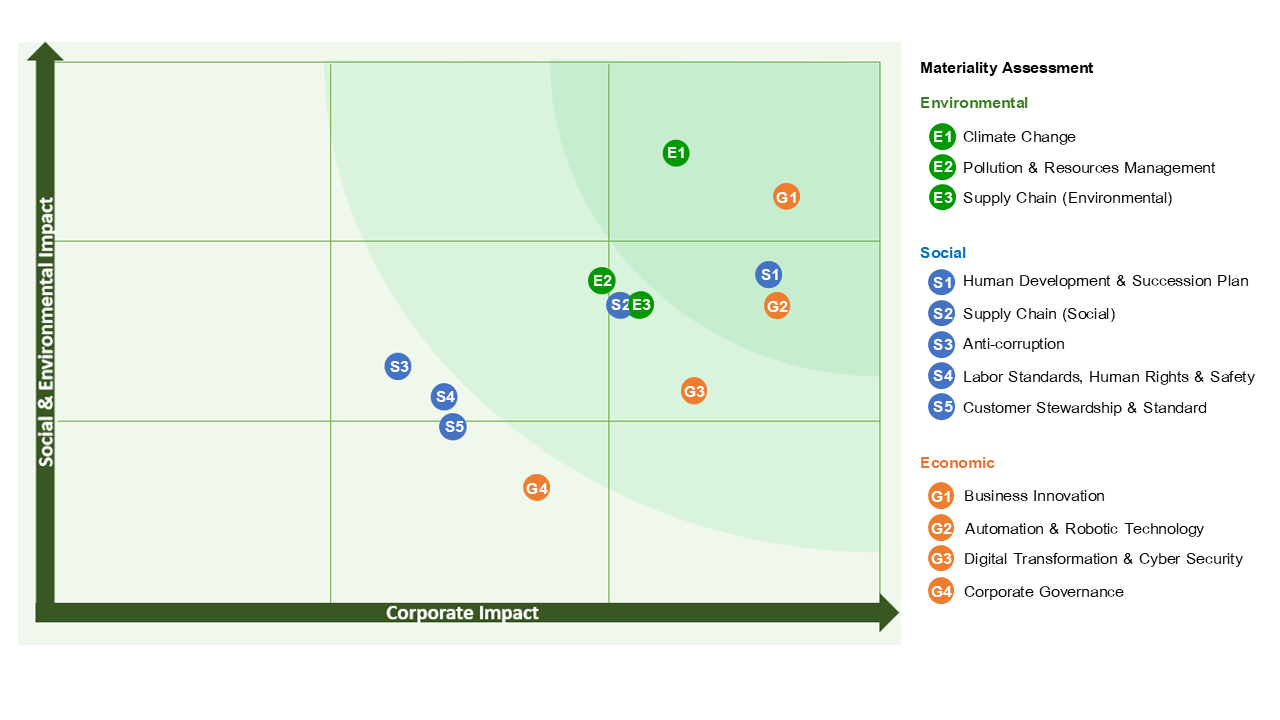
Based on the prioritization of key issues in 2025, there are 12 issues of high sustainability importance to stakeholders and the
company, which are:
Environmental Dimension
- Climate Change Management
- Pollution & Resources Management
- Supply Chain Environmental Impact Reduction
Social Dimension
- Human Resource Development and Succession Planning
- Supply Chain Social Responsibility
- Labor Standards, Human Rights, and Safety
- Anti-Corruption
- Customer Responsibility and Product Standards
Economic Dimension
- Business Innovation
- Automation & Robotic Technology
- Digital Transformation & Cyber Security
- Corporate Governance